
Cotton T-Shirt Printing Guide Malaysia
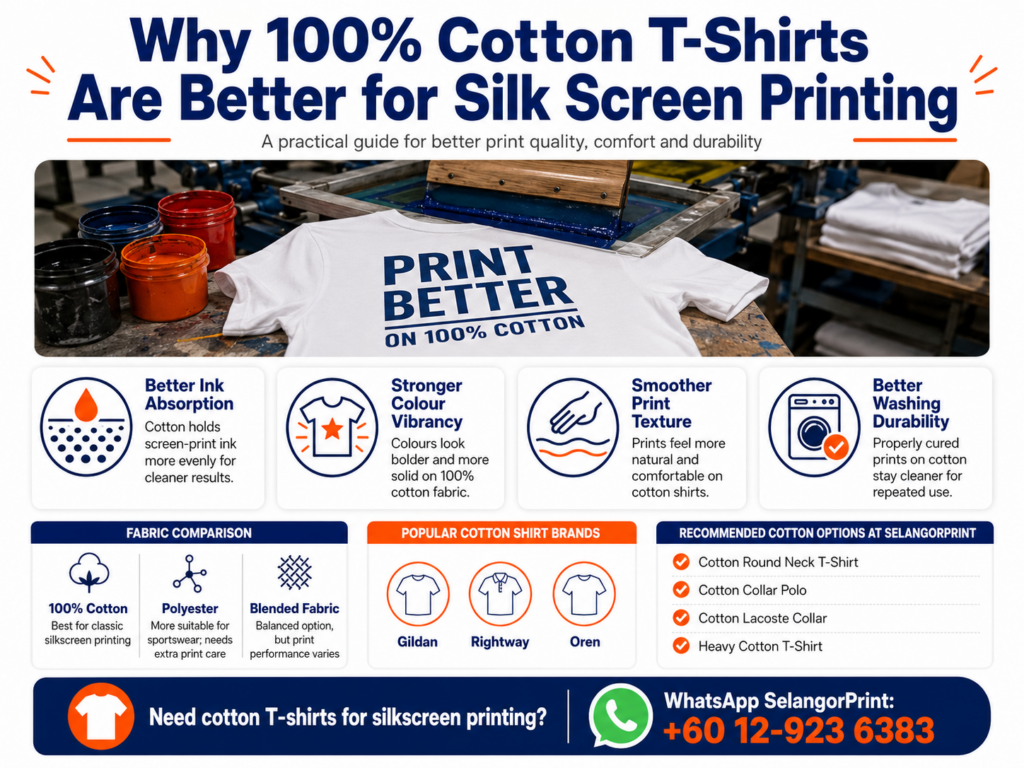
Why 100% Cotton T-Shirts Are More Suitable for Silk Screen Printing
Learn why cotton fabric gives cleaner ink absorption, stronger colour output, better print texture and longer-lasting results for silk screen printing in Malaysia.
Quick summary: If you are looking for baju cotton silk screen printing Malaysia, 100% cotton T-shirts are usually one of the best choices. Cotton absorbs ink better than many polyester or blended fabrics, giving a more solid print, smoother texture and better washing durability when the printing process is done correctly.
When customers order custom T-shirts, one common question is: “Which fabric is best for silkscreen printing?” The answer depends on your design, budget, quantity and usage. However, if your goal is to get a clean, solid and long-lasting print, 100% cotton T-shirts are often the most reliable option.
Silk screen printing is a popular method for corporate T-shirts, event shirts, uniforms, promotional shirts, school shirts and club apparel. It works especially well when the artwork uses solid colours, clear logos, bold text and simple graphics. When paired with the right cotton fabric, the result can look sharp, professional and comfortable to wear.
At SelangorPrint.com, we help customers choose suitable T-shirt materials before printing. For many silkscreen projects, especially bulk orders, 100% cotton remains a strong recommendation because it gives a good balance of comfort, ink performance and premium feel.
What Makes 100% Cotton Better for Silkscreen Printing?
Cotton is a natural fibre with a surface that allows ink to sit and bond well during silkscreen printing. Compared with polyester, cotton usually gives a more stable surface for standard screen printing inks. This helps the print look more even, especially for logos, text and solid-colour designs.
For example, if you are printing a white logo on a navy cotton T-shirt or an orange slogan on a black cotton shirt, the ink can appear more solid and controlled. On certain polyester fabrics, the result may require extra care because polyester behaves differently under heat and may react differently with ink.
This is why many businesses, schools, clubs and event organisers still prefer cotton T-shirts for classic silkscreen jobs. Cotton is easy to wear, easy to print and suitable for many daily-use apparel projects.
Ink Absorption: The Main Reason Cotton Performs Well
Ink absorption is one of the biggest reasons 100% cotton works well with silk screen printing. Cotton fibres allow the ink to hold better on the fabric surface. When the ink is applied, cured and dried properly, the print can achieve a stronger bond with the shirt.
Polyester and blended fabrics can still be printed, but they may require specific ink types, temperature control and extra testing. Some synthetic fabrics have smoother or less absorbent surfaces, which can make ink bonding more challenging. If the wrong ink or process is used, the print may not be as durable or may feel less natural on the shirt.
Why cotton absorbs ink better:
- Natural fibre surface: helps ink sit more evenly on the fabric.
- Better ink bonding: suitable for solid logos and bold designs.
- Less technical risk: easier to handle than many synthetic fabrics.
- Comfortable finish: print can feel more natural when done correctly.
Colour Vibrancy: Why Prints Look More Solid on Cotton
Colour vibrancy is very important for branding. If your company logo, school emblem or event artwork looks dull, the whole shirt can appear less professional. On 100% cotton, silkscreen colours often look stronger because the ink can be laid down with good coverage.
For simple colour designs, cotton helps create a clean and bold finish. This is especially useful for corporate T-shirts, campaign shirts and promotional apparel where the logo must be easy to see from a distance.
For polyester, colour output can still be good, but the printer must consider fabric type, ink compatibility and heat settings. Some polyester materials may also require special inks to reduce dye migration, especially on darker fabrics. For many customers who want a straightforward and reliable print, cotton is the safer choice.
Print Texture: Cotton Gives a More Natural Feel
Another advantage of cotton is print texture. A well-printed silkscreen design on cotton can feel smooth, balanced and comfortable. Because cotton has a natural fabric texture, the ink can sit nicely without making the shirt feel overly plastic or stiff.
This matters a lot for shirts that are worn regularly. Staff uniforms, school shirts, club T-shirts and event shirts should not only look good; they should also feel comfortable. If the print is too thick or the fabric does not pair well with the ink, customers may feel uncomfortable after wearing the shirt for long hours.
Best design types for cotton silkscreen:
- Company logo on left chest
- Large event logo on front or back
- School, club or association T-shirts
- Promotional campaign slogans
- One-colour to three-colour artwork
- Bulk corporate T-shirt orders
Washing Durability: Why Cotton Holds Up Well
Durability is one of the biggest concerns in T-shirt printing. Customers want the print to stay clean after multiple washes. With proper ink, correct curing and good washing care, silkscreen printing on cotton can last very well for normal daily use.
Cotton handles silkscreen printing effectively because the ink can bond well to the fabric surface. Once cured properly, the print becomes more wash-resistant. However, the final durability still depends on the quality of the ink, the printing process, the curing temperature and how the shirt is washed.
Care tips for longer-lasting cotton silkscreen shirts:
- Wash the shirt inside out.
- Use normal or cold water.
- Avoid strong bleach.
- Do not iron directly on the printed area.
- Avoid very high dryer heat.
- Dry under shade when possible.
100% Cotton vs Polyester vs Blended Fabric
Polyester and blended fabrics have their own advantages. Polyester is commonly used for sportswear because it is lightweight and quick-drying. Blended fabrics can offer a balance between comfort and cost. However, for classic silkscreen printing, especially for solid logos and corporate T-shirts, 100% cotton is often easier to manage and gives a more natural finish.
| Fabric Type | Silkscreen Performance | Best Use Case |
|---|---|---|
| 100% Cotton | Good ink absorption, strong colour output and comfortable print texture. | Corporate shirts, event shirts, school shirts and promotional T-shirts. |
| Polyester | Can be printed, but may need special ink and extra process control. | Sportswear, jersey, dry-fit shirts and outdoor activities. |
| Blended Fabric | Depends on cotton-polyester ratio and fabric surface. | Budget uniforms, casual shirts and general promotional apparel. |
Popular Cotton T-Shirt Brands for Silkscreen Printing
For customers who want reliable cotton shirts for printing, several brands are commonly used in Malaysia. Popular options include Gildan, Rightway and Oren. These brands are often chosen for corporate T-shirts, event shirts, uniforms and bulk promotional orders.
Gildan is widely recognised for its cotton T-shirts and international availability. Rightway is commonly used for practical, budget-friendly apparel orders. Oren is also popular for local uniform and promotional apparel needs. The best choice depends on your budget, cutting preference, fabric thickness, colour availability and print quantity.
Recommended Cotton Options at SelangorPrint
When Should You Choose Cotton for Silkscreen Printing?
Choose 100% cotton if your project focuses on comfort, print quality and daily wear. Cotton is especially suitable for company uniforms, school shirts, event T-shirts, promotional campaigns and casual brand merchandise. It works best when your design uses solid colours, bold graphics and clear text.
For sports jerseys or high-sweat outdoor activities, polyester may still be more suitable because it dries faster. For full-colour artwork, DTF or sublimation may be better depending on the fabric. But for classic silkscreen printing, 100% cotton remains one of the safest and most professional choices.
Explore More Printing Services at SelangorPrint
Besides baju cotton silk screen printing Malaysia, you can also explore other printing services to choose the best method for corporate shirts, uniforms, event apparel and bulk orders.
FAQ: Baju Cotton Silk Screen Printing Malaysia
1. Is 100% cotton best for silkscreen printing?
For many classic silkscreen projects, yes. Cotton offers good ink absorption, solid colour output and comfortable print texture.
2. Can polyester be used for silkscreen printing?
Yes, but it may require suitable ink, proper heat control and testing depending on the fabric type.
3. Which brands are popular for cotton T-shirt printing?
Gildan, Rightway and Oren are among the popular shirt brands commonly used for T-shirt printing in Malaysia.
4. Is cotton suitable for corporate uniforms?
Yes. Cotton round neck T-shirts and cotton collar polo shirts are suitable for corporate apparel, staff uniforms and event wear.
Need Cotton T-Shirts for Silkscreen Printing?
The SelangorPrint team can help you choose suitable 100% cotton T-shirts, cotton collar options, print size, ink method and quantity for your project.
We provide cotton silkscreen printing for corporate shirts, event apparel, school shirts, club T-shirts and promotional bulk orders across Selangor, Klang Valley and Malaysia.
WhatsApp SelangorPrint: +60 12-923 6383