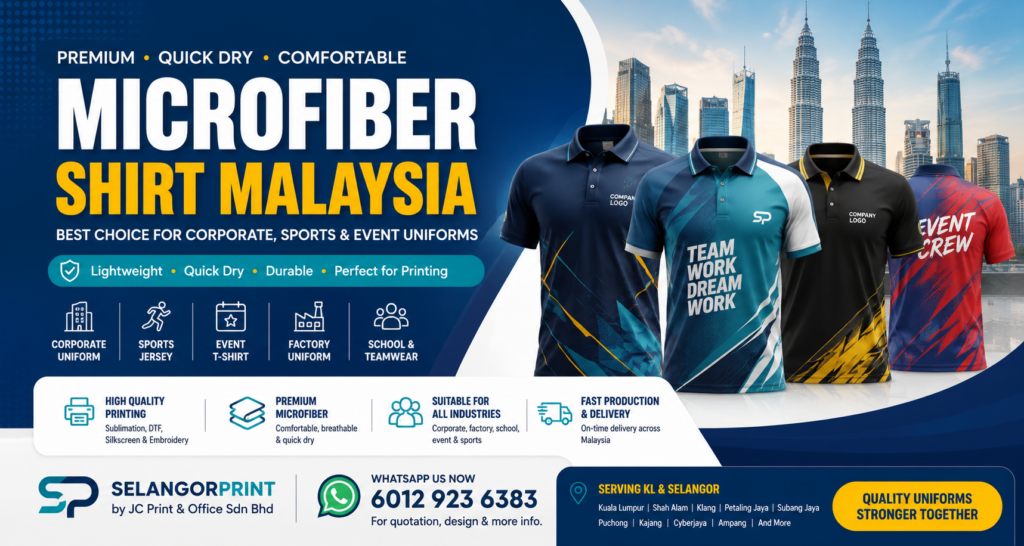
Microfiber Shirt Malaysia: Complete Guide for Corporate, Sports & Event Uniforms in KL & Selangor
Everything you need to know before ordering your next batch of microfiber uniforms — from fabric specs and printing methods to supplier selection and local coverage across Klang Valley.
📋 In This Guide
Malaysia's climate doesn't forgive cheap uniform choices. At 32°C with 80% humidity on a typical working day, the difference between a well-chosen fabric and a poor one shows up within the first hour — and it shows on your team.
Over the past decade, microfiber shirts have quietly become the default choice for Malaysian businesses serious about staff appearance and comfort. Walk into any corporate office in Petaling Jaya, any factory floor in Shah Alam, any sports event in Subang Jaya, and you'll find teams wearing some form of microfiber uniform.
The question isn't whether microfiber works — it's whether you're choosing the right variant, the right printing method, and the right supplier for your specific needs.
This guide was written to answer exactly that. Whether you're an HR manager sourcing 200 shirts for a company event, a school administrator planning sports day jerseys, or a factory owner standardising floor uniforms, this is the most practical reference you'll find in Malaysia.
What Is a Microfiber Shirt?
Microfiber is a synthetic textile made from ultra-fine polyester fibres — typically less than one denier in thickness. To put that in perspective, a single microfiber strand is thinner than a human hair. When woven together into a fabric, these fibres create a dense yet lightweight material with a smooth, almost silky surface.
The vast majority of microfiber shirts sold in Malaysia are made from 100% polyester microfiber, though some performance blends include a small percentage of spandex (typically 5–10%) for added stretch. The fabric weight for uniforms usually sits between 130gsm and 180gsm — heavier than a typical sports jersey but lighter than a standard polo.
How Microfiber Manages Heat and Moisture
The science behind microfiber's comfort comes down to its structure. Those densely packed fibres create thousands of tiny air pockets that allow heat to dissipate away from the body. Unlike cotton, which absorbs moisture and stays wet, microfiber moves sweat to the outer surface of the fabric where it evaporates rapidly — a process called moisture wicking.
In practical terms: when a microfiber shirt feels damp during physical activity, it dries within minutes. A cotton shirt in the same conditions stays wet, becomes heavy, and clings uncomfortably to the skin.
Common Types of Microfiber Used for Uniforms
- Standard Microfiber Polo — Collar design, suitable for corporate and service industries
- Round Neck Microfiber — Event shirts, team uniforms, casual corporate wear
- Microfiber Sports Jersey — Lighter weight, optimised for athletic performance
- Microfiber Collar Tee — Hybrid between polo and round neck, popular for events and promotions
Why Malaysian Companies Prefer Microfiber Shirts
There's a reason microfiber has become the dominant uniform fabric across Malaysia's commercial landscape — and it's not just about price. It's about practical fit for the Malaysian work environment.
The Climate Factor
Malaysia's equatorial climate means heat and humidity year-round. Unlike temperate countries where seasonal uniform planning is standard, Malaysian businesses need a fabric that performs consistently in conditions where an outdoor worker may sweat through a cotton shirt within an hour of starting their shift. Microfiber handles this without compromising appearance.
Low Maintenance, High Durability
Cotton uniforms fade, shrink, and require ironing to maintain a presentable look. Microfiber shirts, by contrast, retain their shape and colour through repeated commercial washing cycles. Most microfiber uniforms used in factory settings comfortably survive 100+ wash cycles without visible deterioration — a significant consideration when ordering 500 shirts or more.
Cost-Effectiveness at Scale
When purchasing in volume — say, 50 to 1,000 pieces — microfiber shirts typically cost less per unit than equivalent cotton alternatives, especially when factoring in longevity. For a company sourcing annual uniforms, switching to microfiber often reduces the effective cost per shirt by 20–30% over the uniform's lifespan.
Professional Appearance
Modern microfiber fabrics have a smooth, structured drape that photographs well and maintains a clean, professional look throughout a working day. This has made them the preferred choice for customer-facing roles in hospitality, retail, and corporate environments where brand image matters.
For businesses across Klang Valley and beyond, SelangorPrint has been one of the go-to sources for corporate microfiber uniforms with full in-house production capability.
Top Benefits of Microfiber Shirts for Malaysian Uniforms
Here's a closer look at why microfiber consistently comes out on top when Malaysian buyers evaluate uniform fabrics.
Quick Dry
Microfiber dries 3–5x faster than cotton. In a Malaysian climate, this means a shirt worn during an outdoor event or factory shift feels fresh throughout the day — even after heavy perspiration.
Lightweight
At 130–180gsm, microfiber shirts feel noticeably lighter than cotton equivalents. Less weight means less fatigue, especially for staff on their feet for 8+ hours in warm conditions.
Durable
Polyester microfiber is inherently resistant to pilling, tearing, and colour loss. Properly cared for, microfiber uniforms can last 2–3 years of regular use without visible wear.
Wrinkle Resistant
Microfiber doesn't crease the way cotton does. Pull it from the dryer or storage, and it looks presentable without ironing — a genuine time-saver for large teams.
Comfortable Fit
The smooth texture of microfiber sits gently against the skin without the scratchiness of some synthetic fabrics. Spandex-blend variants add stretch for active roles.
Scalable for Large Orders
Microfiber is consistently available in large quantities with consistent quality across batches — critical when ordering 300–1,000 shirts for a corporate rollout or event.
Excellent Print Surface
Polyester microfiber accepts sublimation printing with exceptional vibrancy and wash-fastness. It also works well with DTF, silkscreen, and embroidery for different design requirements.
Microfiber vs Cotton vs Honeycomb Polo vs Dry-Fit: Which Should You Choose?
This is the question almost every purchasing executive asks. Here's an honest comparison across the fabrics you're most likely to encounter from Malaysian uniform suppliers:
| Criteria | Microfiber | Cotton | Honeycomb Polo | Dry-Fit |
|---|---|---|---|---|
| Comfort in Heat | Excellent | Moderate | Good | Excellent |
| Moisture Wicking | Excellent | Poor | Moderate | Excellent |
| Quick Dry Speed | Very Fast | Slow | Moderate | Very Fast |
| Durability | Very High | Moderate | High | Moderate |
| Sublimation Printing | Excellent | Not Suitable | Not Suitable | Good |
| DTF / Silkscreen Print | Excellent | Excellent | Good | Good |
| Corporate Appearance | Premium Look | Classic Look | Structured Look | Casual Look |
| Cost Per Unit | Low–Mid | Mid | Mid–High | Low |
| Wrinkle Resistance | Excellent | Poor | Moderate | Excellent |
| Shrink Resistance | Does Not Shrink | Shrinks | Minimal | Does Not Shrink |
| Best Use Case | Corporate, Factory, Events, Sports | Formal, Office, High-End Polo | Senior Management, Reception | Sports, Roadshows, Casual Events |
Best Printing Methods for Microfiber Shirts in Malaysia
Choosing the right printing method is as important as choosing the right fabric. Get it wrong, and even the best microfiber shirt looks cheap within a few washes. Here's how the main options compare for polyester microfiber:
Top Pick Sublimation Printing
Sublimation uses heat and pressure to permanently infuse dye molecules into polyester fibres. The result is a print that becomes part of the fabric itself — it won't crack, peel, or fade even after hundreds of washes.
Best for: Sports jerseys, full-coverage designs, events with vibrant colour requirements, team uniforms with gradients or photographic artwork.
- Full-colour, unlimited design complexity
- No additional texture — fabric remains smooth
- Requires white or light-coloured base fabric
- Only works on 100% polyester (microfiber is ideal)
- Extremely durable — lasts the life of the garment
Versatile DTF Printing
Direct-to-Film (DTF) printing transfers a full-colour design from a special film onto the shirt using heat. Unlike sublimation, DTF works on both light and dark fabrics and isn't limited to polyester.
Best for: Corporate shirts with logos on dark microfiber, small-run orders, designs on coloured shirts where sublimation won't work.
- Works on any colour fabric
- Suitable for small quantities (even single pieces)
- Produces bright, crisp colours
- Slight raised texture on print surface
- Excellent durability with proper wash care
Classic Silkscreen Printing
Silkscreen (screen printing) pushes ink through a mesh stencil directly onto the fabric. It's the traditional method for mass uniform production and remains the most cost-effective for large orders with limited colours.
Best for: High-volume orders (200+ pieces) with 1–4 colour logos, factory uniforms, event shirts with consistent branding.
- Lowest cost per unit at high volumes
- Ink sits on fabric surface — slightly raised feel
- Excellent for spot colour logos and text
- Minimum order typically 50–100 pieces per colour
- Colour matching to Pantone standards available
Premium Embroidery
Embroidery stitches a design directly into the fabric using thread. It produces a premium, three-dimensional finish that elevates a microfiber polo shirt from uniform to branded corporate wear.
Best for: Corporate management shirts, hospitality uniforms, reception staff, branded polo shirts where a premium appearance is required.
- Durable — virtually never wears off
- Premium tactile quality — preferred in high-end environments
- Best suited for logos under 10cm wide
- Not ideal for complex, detailed artwork or gradients
- Can be combined with sublimation or DTF on the same shirt
Industries That Commonly Use Microfiber Shirts in Malaysia
Microfiber has penetrated virtually every sector of the Malaysian economy that requires staff uniforms. Here's where it's most commonly deployed — and why:
Corporate Offices
Factories & Manufacturing
Schools & Institutions
Sports Teams & Clubs
Restaurants & F&B
Construction Companies
Government Departments
Event Organisers
Logistics & Courier
Security Companies
A Note on Industry-Specific Requirements
Different industries have different priorities. A security company needs a structured, authoritative look with consistent colour matching across large teams. A restaurant needs fabric that handles food-industry washing without fading. A school needs breathable fabric that holds up through sports activities and daily wear.
Understanding these nuances is part of what makes a good uniform supplier. SelangorPrint works with clients across all these sectors and tailors fabric and printing recommendations accordingly.
For businesses operating in Johor, UniformJohor.com offers a dedicated regional service. Companies serving East Malaysia, particularly Sabah, may find the specialist services at UniformSabah.com better suited to their location.
Microfiber Shirt Printing Coverage Across KL & Selangor
SelangorPrint serves businesses across the entire Klang Valley — from Mont Kiara to Klang, Cyberjaya to Rawang. Here's where we deliver.
📍 Kuala Lumpur
📍 Selangor
Not in Klang Valley? We also offer nationwide delivery across Peninsular Malaysia. WhatsApp us to confirm your location.
Real Business Use Cases for Microfiber Shirts in Malaysia
Abstract fabric specs only go so far. Here's how real Malaysian businesses are actually using microfiber uniforms — and what makes each application successful.
Factory Floor Uniforms — Shah Alam Manufacturing Plant
A mid-sized electronics manufacturer in Shah Alam needed 600 uniforms for their production floor staff. Requirements: dark navy colour, company logo on chest, comfortable for 10-hour shifts in a warm factory environment. Solution: 160gsm navy microfiber polo with silkscreen chest logo. Outcome: 40% reduction in complaints about uniform comfort within the first quarter; uniforms still looking presentable after 18 months of daily use.
Sports Day Jerseys — Secondary School, Subang Jaya
A national secondary school in Subang Jaya needed 400 jerseys for their annual sports day — four house teams, 100 jerseys each, with individual house colours. Solution: full sublimation printing on lightweight 130gsm microfiber round neck jerseys. Each house received a unique full-colour design including house emblem and student names on the back. Delivered in 8 working days.
Corporate Roadshow — KLCC & Bukit Bintang Activation
A telecommunications company running a 3-day roadshow across KLCC and Bukit Bintang needed branded shirts for 80 activation staff. Requirements: vibrant brand colours with photographic-quality logo, ready in 5 days, comfortable for long outdoor shifts. Solution: sublimation-printed microfiber collar tees in brand red and white. The shirts retained full colour integrity across all three outdoor event days.
Team Building Shirts — Petaling Jaya Corporate Group
An accounting firm in Petaling Jaya needed 120 identical team building shirts for their annual retreat in Langkawi. They wanted something that worked both as an activity shirt and a casual wear item staff would actually keep. Solution: 150gsm microfiber round neck with DTF-printed full-colour logo on chest and staff name on sleeve. Positive feedback from staff; multiple team members requested additional pieces for personal use.
Restaurant Uniforms — F&B Chain, Puchong
A growing F&B chain with 6 outlets across Puchong and Kuchai Lama needed a consistent front-of-house uniform that looked clean, resisted food stains, and washed easily. Solution: dark charcoal microfiber polo with embroidered logo — the embroidery holds its shape and quality through the high-frequency commercial washing typical in restaurant environments.
School Uniform Programme — Klang Primary School
A Chinese primary school in Klang adopted microfiber as their new PE uniform fabric after cotton PE shirts proved uncomfortable and slow-drying in the Malaysian heat. The school ordered 800 pieces in two sizes, with silkscreen school name and crest. Parents reported significantly less discomfort from students during and after PE lessons.
How to Choose the Right Microfiber Shirt Supplier in Malaysia
The Malaysian uniform printing market is crowded. Not all suppliers offer the same quality, capability, or service consistency. Here's what to look for — and what questions to ask before committing your order.
In-House Production — Suppliers with in-house printing and cutting facilities have better quality control and faster turnaround than those outsourcing to third parties.
Multiple Printing Capabilities — Look for suppliers who offer sublimation, DTF, silkscreen, and embroidery under one roof. This means they can recommend the best method for your design, not just the one they happen to have.
Fabric Sample Available — Any credible supplier should be able to provide a fabric sample before you commit to an order. This lets you assess weight, texture, and finish in person.
Response Time — A supplier who takes 3 days to respond to a quotation request will likely take 3 weeks to resolve a production issue. Test response time before ordering.
Delivery Track Record — Ask about typical turnaround and whether delivery commitments are regularly met. Check reviews from previous clients in similar industries.
Fabric Range & Quality — Do they offer multiple microfiber weights and types? A supplier with limited fabric options may push you toward what they have rather than what you need.
Transparent Pricing — Request an itemised quotation. Be cautious of suppliers who provide a lump-sum price without breaking down fabric cost, printing cost, and setup fees.
Pre-Production Mockup — A good supplier will provide a digital proof or printed sample before proceeding with full production. This prevents costly errors in large orders.
For wider printing and branding solutions, businesses may also explore KitaPrint.co — a one-stop printing and branding platform — or the parent company JCPrintMalaysia.com for nationwide printing requirements.
Why Choose SelangorPrint for Your Microfiber Uniform Order?
SelangorPrint by JC Print & Office Sdn Bhd has built its reputation as Klang Valley's most comprehensive in-house uniform printing operation. Here's what that means practically for your order:
Fully In-House Production
Cutting, printing, and quality checking all happen under one roof. No outsourcing means tighter control and more predictable delivery timelines.
4 Printing Methods Available
Sublimation, DTF, silkscreen, and embroidery — all available in-house. The right method is recommended for your design, not your supplier's convenience.
Corporate & Event Specialists
From boardroom polo shirts to 1,000-piece roadshow shirts, we handle orders at every scale with the same level of attention to colour accuracy and finish.
Sports Jerseys & School Uniforms
Schools, sports clubs, and competition teams across Selangor and KL rely on SelangorPrint for sublimation jerseys and PE uniforms year-round.
Factory & Logistics Uniforms
We understand the unique requirements of industrial uniforms — durability, wash cycle survival, and consistent quality across large repeat orders.
Malaysia-Wide Delivery
While we're based in Selangor, we deliver across Peninsular Malaysia. Businesses in Johor may also work with our partner UniformJohor.com.
Frequently Asked Questions
Common questions from Malaysian buyers before placing a microfiber uniform order.
Q
Is microfiber better than cotton for Malaysian uniforms?
Q
Does microfiber shrink after washing?
Q
Can microfiber shirts be embroidered?
Q
Is microfiber suitable for corporate uniforms?
Q
Is microfiber suitable for sports teams?
Q
What is the minimum order quantity (MOQ) for microfiber shirts?
Q
Which printing method lasts the longest on microfiber?
Q
How long does production take?
Q
Can microfiber shirts be sublimation printed?
Q
How do I get a quotation from SelangorPrint?
Ready to Order Your Microfiber Uniforms?
Talk to our team about fabric options, printing methods, and pricing — no commitment required. Same-day quotations available via WhatsApp.
Or visit selangorprint.com to browse our full range of uniform fabrics and services.
📊 SEO Output Reference
Microfiber Shirt Malaysia | Corporate & Sports Uniforms
Best microfiber shirt supplier in Malaysia. Corporate, sports & event uniforms with sublimation, DTF, embroidery. Serving KL & Selangor. WhatsApp for quote.
/microfiber-shirt-malaysia
- microfiber shirt malaysia corporate uniform selangorprint
- sublimation printing microfiber jersey malaysia
- custom microfiber polo shirt corporate uniform KL
- microfiber sports jersey printing selangor
- factory uniform microfiber shirt shah alam malaysia
- Link from "sublimation printing malaysia" page → this article
- Link from "corporate uniform malaysia" page → this article
- Link from "DTF printing malaysia" page → this article
- Link from "event shirt malaysia" page → this article
- Link from homepage uniform section → this article
- Link from "uniform supplier selangor" page → this article
- Article — Primary content schema
- FAQPage — For the 10 FAQ items (rich snippet eligibility)
- LocalBusiness — SelangorPrint with address, phone, areaServed
- BreadcrumbList — For navigation path
- Sublimation Printing Malaysia: Complete Guide for Jerseys & Event Shirts
- Cotton vs Microfiber vs Honeycomb Polo: Which Uniform Fabric Suits Malaysian Business?
- DTF Printing Malaysia: What It Is and When to Use It for Uniforms
- Corporate Uniform Design Tips: How to Make Your Team Look Professional
- How to Order Bulk Uniform Shirts in Malaysia Without Costly Mistakes
- School Uniform Printing Malaysia: Complete Guide for Administrators
- Sports Day Jersey Design Ideas for Malaysian Schools & Clubs
- Best Fabric for Factory Uniforms in Malaysia's Hot & Humid Climate