
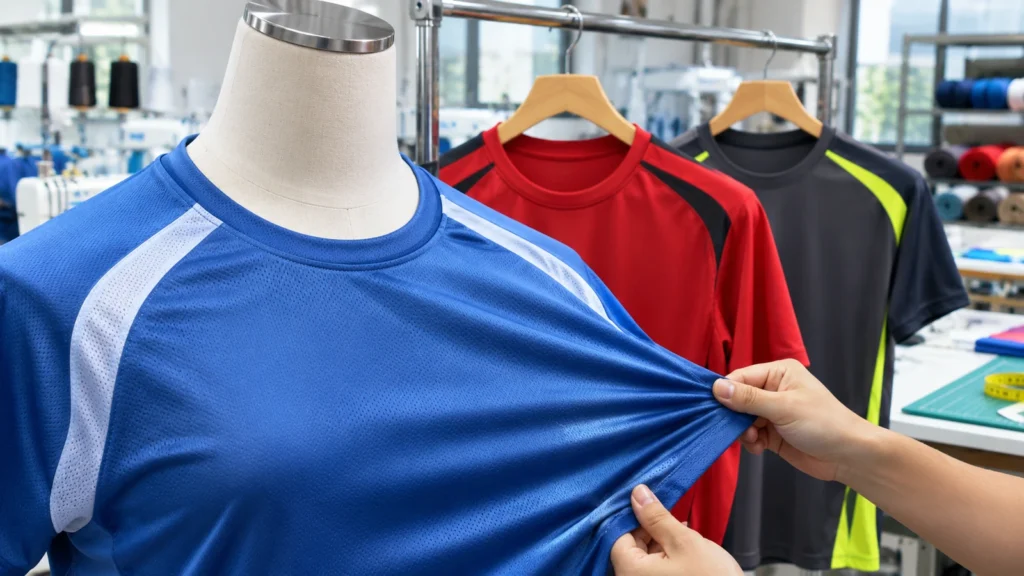
Round-Neck Team Jerseys: Size-Chart Handover and Order Accuracy
Team jersey orders often go wrong after the design is approved. Sizes arrive from different group chats, names are revised without a central list and the chosen size chart may belong to an older garment model. A smooth round-neck jersey order needs a controlled handover from coach or organiser to production, with fit, names and quantities checked together before printing begins.

Use the chart for the exact jersey pattern
Do not assume the fit of a general cotton tee equals a custom polyester sports jersey. Measure chest width, body length, shoulder and neckline according to the supplier’s illustrated method. Some designs are relaxed, while others are more athletic. Ask whether sizing is based on the finished garment or body measurements.
For the purchase approval, share the current chart and one photographed fitting sample with all participants. This is worth recording before the design is signed off, because using an unrelated chart produces systematic errors that cannot be corrected by the artwork team.
Separate wearer choices from production data
A coach can collect preferred sizes, but the production list should contain the final selected size, garment model, player name, number and quantity in defined columns. Avoid including unrelated personal information. Use one coordinator to resolve duplicate numbers and spelling variations before submission. Distinguish shirt-only orders from shirt-and-shorts sets if applicable.
A useful verification step is to validate column formats and total pieces before sending the final spreadsheet. The practical reason for that check is that free-text messages can cause duplicated orders and missing players.
Test neckline and shoulder comfort
Round-neck jerseys may use ribbed or self-fabric finishes; size alone does not determine neck comfort. Have a representative sample tried on during realistic movement. The opening must allow easy dressing without pulling hard at shoulder seams, and the collar should recover its shape. Check both the smallest and largest requested sizes when the group has a broad range.
During the production review, record the accepted fit and collar finish with the model code. Skipping this step can cause a surprisingly expensive problem: an attractive jersey may still be rejected for a tight or loose neckline.
Make names and numbers legible across sizes
A number dimension that looks balanced on a large adult back may be too wide for a small shirt. Define proportional placement rules and minimum readability requirements rather than scaling automatically. Contrast must work on the printed garment background, and names should not disappear beneath collars or repeated motifs. Inspect the actual sample layout.
The team should also proof one small and one large player jersey at actual print scale. Treat this as part of the specification rather than an informal preference, since oversized names can interfere with seams or create cramped spacing.
Freeze a version before production
Changes after confirmation are a common source of error. Give the final list a revision number and cutoff date, and have the organiser approve a summary of every player name, number and size. Keep a separate field for special instructions instead of editing the master artwork. Make clear what happens when a late change is requested.
Before a supplier prepares the final proof, request explicit sign-off on the last consolidated list, not separate private messages. The risk is operational as much as visual: multiple competing spreadsheets can cause correct names to be paired with wrong sizes.
Prepare receiving and distribution controls
When the jerseys arrive, compare cartons and individual items with the approved list. Sort by team, size or player according to the delivery arrangement. Photograph any print or stitching defect before distributing items. Save the accepted specification for future seasons and do not assume the next model will grade identically.
For a repeat order, use a simple check-off sheet when issuing jerseys to the team. Keep the result with the approved sample, since an inaccurate handover can turn a successful print job into a difficult distribution day.
Practical example: making the decision
A community sports organiser receives jersey sizes through several messaging groups, with one list using youth labels and another using adult sizes. Rather than combining them immediately, the organiser obtains the chart for the exact jersey model and arranges a short fitting session for uncertain players. Names and numbers are then checked by a second coordinator against one clean master spreadsheet. The design team tests the smallest and largest back-number layouts to make sure the collar and side seams do not interfere. A final revision is signed off before production, and received items are checked against the same sheet before distribution. The process does not promise that all late changes can be accepted; it establishes when information is final and who has authority to make a correction.
Additional approval considerations
Receiving staff should understand the final jersey list before cartons arrive. If player names and numbers are packed by size, distribute with a check-off sheet; if they are packed by team, verify the bundle totals separately. Put the approved revision on the delivery record so a late WhatsApp instruction does not become the unofficial master.
For future reorders, save garment measurements and the approved neckline sample alongside artwork. A different supplier's medium size may not match the original model, and a changed rib collar can affect comfort even when the body print is unchanged. That distinction helps teams avoid repeating the same errors year after year.
- Share the current chart and one photographed fitting sample with all participants.
- Validate column formats and total pieces before sending the final spreadsheet.
- Record the accepted fit and collar finish with the model code.
- Proof one small and one large player jersey at actual print scale.
- Request explicit sign-off on the last consolidated list, not separate private messages.
- Use a simple check-off sheet when issuing jerseys to the team.
An additional control is to share the current chart and one photographed fitting sample with all participants. Combine that check with a final handover step: use a simple check-off sheet when issuing jerseys to the team. Keep both results with the dated approval sample so a replacement order uses the same reference. Where the material, delivery address or production technique changes, ask for a fresh confirmation rather than assuming that an old quotation covers the new combination.
Frequently asked questions
Can an ordinary T-shirt size chart be used?
Only if it matches the exact jersey pattern and measurements; otherwise use the garment-specific chart.
When should player names be frozen?
Before the production file is finalised, with one authorised sign-off.
Should number size be the same on youth and adult shirts?
Use size-aware placement rules and inspect representative samples.
What should the receiving team count?
Total pieces, each player name, number, size and any agreed variants.
For a quotation based on the actual garment, print method, quantity and delivery location, review SelangorPrint services and use the official enquiry page. Prices, methods, production schedules and minimum quantities must be confirmed for the specific job.