
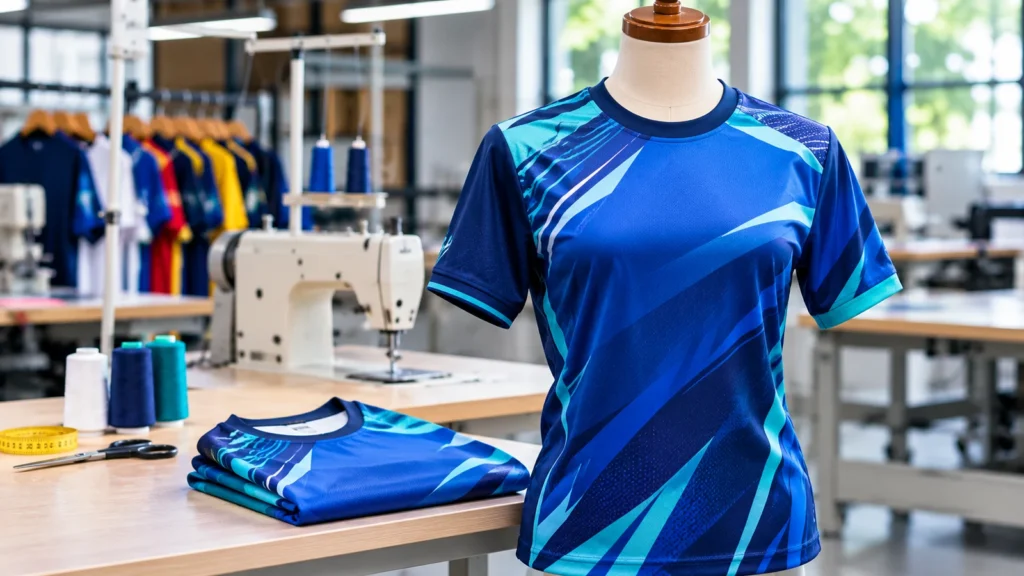
Team Jersey Reorders: Adding New Players Without Changing the Original Colours
Team Jersey Reorders: Adding New Players Without Changing the Original Colours is fundamentally a practical specification problem for a Selangor sports organiser ordering extra jerseys months after the first production run. The value of an early sample is not simply visual reassurance; it gives the buyer a chance to correct a problem before it affects a full order. The aim is to choose a result that the actual users can accept and the supplier can reproduce. For Selangor deliveries or collection, choose the correct receiving address and confirm arrangements at the quoted location before staff travel or allocate unloading time.

Archive the original garment specification
Before choosing a specification, look at the role that the item must perform. A player name and number alone are not enough to reproduce a jersey after several months. A jersey is sewn from shaped panels, so a two-dimensional picture does not show the finished alignment of every seam, collar and sleeve. A practical quotation should make this choice visible, so competing suppliers are pricing the same item.
Save fabric type, pattern, colour references, cut and approved artwork. Keep a dated photograph or annotated sample with the sign-off rather than relying on memory. A visually similar replacement fabric may print differently. Document what was checked and keep the proof alongside the order. A verbal agreement is much harder to audit when another batch is needed.
Check the changed roster as a data file
New players must be added without accidentally recreating the old roster or repeating numbers. For a Selangor sports organiser ordering extra jerseys months after the first production run, this affects both the finished appearance and the way the order can be checked after delivery. The selected polyester fabric and print process both affect colour appearance. A printed test is more dependable than treating screen RGB values as a production guarantee. This distinction is useful for both first-time orders and replacements to an existing uniform programme.
Compare the supplement against the original master list before export. Ask an independent reviewer to compare the proof against the original requirement. Individual text messages are unreliable records for personalisation. This is especially useful for a mixed group, where the smallest garment or most demanding role may reveal issues a standard sample does not.
Proof panel alignment again
The decision around proof panel alignment again should begin with actual use rather than a generic catalogue promise. A printer may be using a slightly updated cutting template or different size grading. Names, numbers and team colours are data that need ownership and sign-off. A printer cannot know which spelling is intended when two lists disagree. Put the chosen requirement into a written brief and identify which part is non-negotiable.
Check the revised pattern for front, sleeve, side and back continuity. The same check should be used on the actual garment or print model proposed for production. Old artwork cannot automatically be assumed compatible with a new pattern. If the result is marginal, change the specification now rather than asking the production team to improvise during the final run.
Compare an actual colour sample
Before choosing a specification, look at the role that the item must perform. Printed polyester shades can vary with fabric batch and production settings even when RGB values match. Size grading changes the usable panel shape. A logo or number must remain legible on the smallest and largest chosen garments. Put the chosen requirement into a written brief and identify which part is non-negotiable.
Hold a new sample beside a retained first-run jersey under consistent light. The same check should be used on the actual garment or print model proposed for production. A match on a phone screen is not proof of a match in fabric. The point of this check is to make the decision reproducible: another person should be able to read the approval and obtain the same result.
Approval and order checklist
Before the final approval, ask one person who was not involved in the artwork preparation to follow the same checklist and locate the evidence for every item. For a Selangor sports organiser ordering extra jerseys months after the first production run, the final record should identify the selected product or material, the artwork version, the exact quantity by variant, and the receiving address or responsible collector. A sample is useful only if it corresponds to the version that will be made.
- Save fabric type, pattern, colour references, cut and approved artwork.
- Compare the supplement against the original master list before export.
- Check the revised pattern for front, sleeve, side and back continuity.
- Hold a new sample beside a retained first-run jersey under consistent light.
- Ask for an itemised quote for the add-on batch.
For Selangor deliveries or collection, choose the correct receiving address and confirm arrangements at the quoted location before staff travel or allocate unloading time. Retain the supplier reply, signed sample images and dated item list for replacements or later batches. If a requested change affects garment sizing, decoration or packing, ask for the revised specification before approving production, rather than treating it as an informal message.
Frequently asked questions
Which artwork proof is most useful?
A player name and number alone are not enough to reproduce a jersey after several months. Save fabric type, pattern, colour references, cut and approved artwork. A visually similar replacement fabric may print differently. Keep the final decision in the approved order so that a later team member can check it without guessing.
Should names and numbers be checked separately?
New players must be added without accidentally recreating the old roster or repeating numbers. Compare the supplement against the original master list before export. Individual text messages are unreliable records for personalisation. Keep the final decision in the approved order so that a later team member can check it without guessing.
Can the same size chart fit every jersey?
A printer may be using a slightly updated cutting template or different size grading. Check the revised pattern for front, sleeve, side and back continuity. Old artwork cannot automatically be assumed compatible with a new pattern. Keep the final decision in the approved order so that a later team member can check it without guessing.